


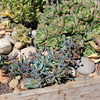
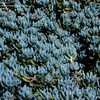
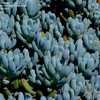
Blue chalksticks, botanically Senecio repens (often sold as Kleinia repens or Curio repens), is a captivating succulent prized for its cylindrical, powder-blue leaves that resemble sticks of chalk. Native to South Africa's Cape region, this drought-tolerant perennial forms dense, spreading mats ideal for rock gardens, xeriscapes, and container plantings.
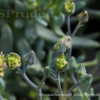
The plant produces finger-like, semi-cylindrical leaves 5–10 cm long, coated in a waxy, glaucous bloom that gives them their signature silvery-blue hue. Stems are prostrate to ascending, rooting at nodes to form a ground-hugging carpet 15–30 cm tall and up to 60 cm wide. In summer, small, rayless yellow flower heads appear on short stalks, though the foliage remains the primary ornamental feature.
| Family: | Asteraceae (ass-ter-AY-see-ee) |
| Genus: | Kleinia (KLINE-ee-uh) / Senecio / Curio |
| Species: | repens (REE-penz) |
| Synonyms: | Cacalia glauca, C. repens, Curio repens, Senecio repens, S. succulentus |
Blue chalksticks excels as a groundcover in frost-free climates, spilling over retaining walls, or as a "thriller" in succulent container combinations. Its cool blue tones contrast beautifully with purple echeverias, golden sedums, or rust-colored stones. In colder zones, grow as a patio specimen and overwinter indoors on a sunny windowsill.
Easily propagated from stem cuttings in spring or summer. Allow cut ends to callous for a day before planting in dry succulent mix. Roots form in 2–3 weeks. Division of established clumps is also effective.
Weed Control Around Blue Agave Without Herbicides
Restoring Blue Color in Blue Spruce: Genetics, Light, and Nutrition
Blue Roses: The Genetic Reality Behind the Marketing
Blue Lobelia: Not a Houseplant, Cool-Climate Annual
Blue Star Creeper (Pratia pedunculata): Tiny Leaves, Starry Blue Flowers for Moist Shade
Wintercreeper Euonymus (Euonymus fortunei): Versatile Evergreen Vine
Sharp-Lobed Hepatica (Anemone acutiloba): Early Spring Woodland Wildflower
Blue Columbine Seedlings Blooming Mauve: Cross‑Pollination
Searching for Euphorbia 'Ferwol' and Blue Foliage Plants for Vancouver
Blue Roses: The Art of Dyed White Roses and Their Symbolic Meaning
Lepismium cruciforme (Trailing Cactus)
Echinocereus scheeri subsp. gentryi: A Clumping, Pink-Flowered Hedgehog
Dicksonia sellowiana (Tree Fern)
Blue Potato Bush (Lycianthes rantonnetii): The Royal Purple Shrub
Copyright © www.100flowers.win Botanic Garden All Rights Reserved