


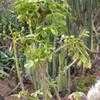
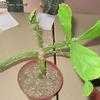
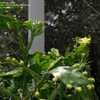
Brazilian Prickly Pear is a distinctive, tree-like cactus that develops a woody trunk and flattened, leaf-like branches (cladodes) resembling those of a Pereskia. It can reach 20–30 feet tall in its native South American habitat. The cladodes are bright green with few spines. Yellow flowers appear on the edges of the cladodes, followed by yellow fruits. It’s a rare example of a cactus with a truly arborescent habit and persistent, photosynthetic flattened stems.
| Family: | Cactaceae (kak-TAY-see-ee) |
| Genus: | Brasiliopuntia (bra-sil-ee-oh-PUN-tee-uh) |
| Species: | brasiliensis (bra-sill-ee-EN-sis) |
| Synonym: | Opuntia brasiliensis |
| Synonym: | Opuntia bahiensis |
| Synonym: | Brasiliopuntia bahiensis |
| Synonym: | Opuntia schulzii |
| Synonym: | Brasiliopuntia schulzii |
Full sun to light shade. Well-drained soil. Regular water in summer; drier in winter. Frost tender; protect below 30°F (-1°C). Rare in cultivation; a botanical curiosity for collectors of tree cacti.

Saguaro Cactus (Carnegiea gigantea): Icon of the Sonoran Desert
Eve's Needle Cactus (Austrocylindropuntia subulata): A Tree-Like Cholla with Awl-Shaped Leaves
Silver Dollar Prickly Pear (Opuntia robusta): A Massive, Blue-Green Padded Cactus for Large Spaces
Texas Prickly Pear (Opuntia engelmannii var. lindheimeri)
Prickly Pear 'Elongated Form' (Opuntia ficus-indica var. decumana)
Baby Rita Prickly Pear (Opuntia 'Baby Rita'): A Dwarf, Purple-Padded Cactus
Prickly Pear Pad Propagation: Yellowing Top on Rooted Cutting
Weeding a Mature Prickly Pear Patch
Prickly Pear Growth Surge After Relocation: Light Response vs. Flowering
Forcing Prickly Pear to Flower: Patience Required
Peruvian Old Man Cactus (Espostoa lanata)
Are All Prickly Pear Cactus Fruits Edible? Most Are, But Handle Spines Carefully
Copyright © www.100flowers.win Botanic Garden All Rights Reserved