


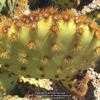
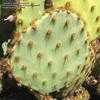
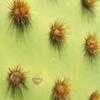
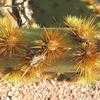
Chenille Prickly Pear, or Old Man Whiskers, is named for its dense covering of long, slender, yellowish to brown glochids (hair-like spines) that give the pads a soft, fuzzy, chenille-like texture—deceptively inviting but painfully irritating. The pads are blue-green; yellow flowers with red centers appear in spring. Native to Texas and Mexico, it’s a conversation piece for its unique spine morphology.
| Family: | Cactaceae (kak-TAY-see-ee) |
| Genus: | Opuntia (op-UN-shee-a) |
| Species: | aciculata (ass-sik-yoo-LAY-ta) |
| Synonym: | Opuntia lindheimeri var. aciculata |
| Synonym: | Opuntia engelmannii var. aciculata |
Full sun, well-drained soil. Drought-tolerant. Hardy to 10°F (-12°C). Handle ONLY with heavy gloves and tongs; glochids detach easily and embed in skin. Use in barrier plantings or as a curiosity in cactus gardens.
Eastern Prickly Pear (Opuntia humifusa)
Brazilian Prickly Pear (Brasiliopuntia brasiliensis): A Tree-Like Cactus with Flattened Branches
Prickly Pear 'Elongated Form' (Opuntia ficus-indica var. decumana)
Baby Rita Prickly Pear (Opuntia 'Baby Rita'): A Dwarf, Purple-Padded Cactus
Cochineal Nopal Cactus (Nopalea cochenillifera): The Historic Dye Cactus
Old Man Cactus (Cephalocereus senilis): White-Haired Columnar Cactus
Engelmann's Prickly Pear (Opuntia engelmannii): A Classic Texas Prickly Pear with Edible Fruits
Mojave Prickly Pear (Opuntia phaeacantha): A Variable, Widespread Prickly Pear with Edible Fruit
Prickly Aloe (Aloe aculeata): A Heavily Armed Aloe
Plains Prickly Pear (Opuntia macrorhiza): A Tuberous-Rooted, Yellow-Flowered Cactus
Eltham Indian Fig (Opuntia dillenii): A Sprawling, Coastal Prickly Pear
Copyright © www.100flowers.win Botanic Garden All Rights Reserved