


When planning a landscape, exploring established garden styles provides a helpful starting point. Understanding the elements that define each style makes it easier to recreate that aesthetic in your own yard. But there's another creative avenue: the theme garden.
A theme garden can be a tranquil sanctuary, a showcase of your favorite colors, or an outdoor extension of your interior decor. It might recreate a childhood fantasy, honor beloved plants or a favorite sport, or simply express something uniquely yours. Theme gardens work at any scale—from an entire property to a cozy corner—and while harmony with the overall landscape is nice, personal joy is the only real requirement.
The possibilities are limited only by imagination. Here are several inspiring concepts to spark your own design.

The Color Garden. Committing to a specific color palette is one of the simplest ways to make a garden distinctly yours. In this space, white becomes the defining element rather than an absence of color—a timeless, classic look.
Design tip: A green-and-white scheme visually cools a garden on hot summer days.

For a bright, sunny feel, yellows, oranges, and reds add vibrancy and hold up well under intense sunlight.

Purples and blues create a restful retreat, perfect for unwinding after a hectic week. Pink offers a softer accent, while orange makes a bolder statement.
Design tip: Whether you prefer cool or warm hues, adding a single plant with a flower color from the opposite side of the color wheel injects energy and a focal point.

A green garden relies on foliage rather than blooms for color, yet achieves surprising complexity. Even within a single-color guideline, foliage and flowers range from yellow to gray and everything between.

The Collector's Garden. When a single plant or plant family captures your passion, feature it prominently. This succulent collection highlights each variety's uniqueness while maintaining a cohesive composition.

Traditional rose gardens showcase individual plants and simplify maintenance—deadheading, feeding, and watering are streamlined when all plants share the same needs. They're also stunning in full bloom and a staple of traditional design.
Design tip: Don't feel bound by convention. Roses thrive when scattered throughout the garden, even in vegetable patches. Some varieties offer edible petals and hips.

The Sanctuary Garden. While gardens are inherently relaxing, a space deliberately designed for tranquility draws you in more often. The key is a simple, almost minimalist aesthetic with a touch of Zen that blends with many garden styles.

A meditation spot can serve multiple purposes: seating, dining, a viewpoint, or—with furniture moved—a peaceful yoga area.
Design tip: Even without a grand view, a small pavilion tucked into a garden corner creates an instant retreat.

A meditation garden outside a breakfast nook ensures a calm start to the day, regardless of how it ends.

Meditation needn't mean stillness. A meditation walk becomes both a garden focal point and a way to center your thoughts. Note how the stones graduate from small to large toward the circle's center.

The Romantic Garden. Classic patio sets, wrought-iron tables, and picnic benches are outdoor staples for good reason. But why stop there? If shabby chic defines your indoor style, extend it outdoors with linens, pillows, and fresh-cut garden flowers—ideal for a tea party, if not everyday practicality.
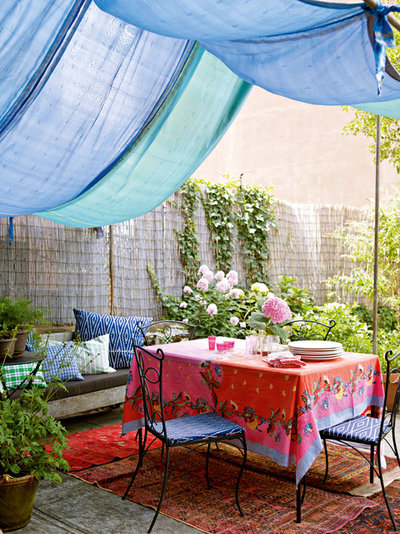
Replace lattice overhead with softly draped panels evoking a luxurious tent. A rug underfoot and ample pillows enhance the ambience, while filtered light prevents the space from feeling dark or closed in.
Design tip: Recreating this look is straightforward—you need fabric supports and long sheets. Secure the fabric firmly or it may blow into other garden areas.

The Play Garden. Balancing play space with garden design is challenging. Instead of relegating play structures to a safe corner, integrate them into the overall design.
Design tip: Matching the play structure's wood and design to the fence and bench unifies the space.

In an otherwise adult space, a bright, child-sized table and chairs create a dedicated spot for little ones.

A climbing wall serves double duty: by day it's for practicing holds; by night it's a colorful accent in a neutral space.
Design tip: Echoing the wall's color in random patio squares adds a playful touch.

For chess enthusiasts, a giant chessboard lets you watch the action from a distance—though perhaps not quite Harry Potter scale.

A tropical beach in a Chicago yard? With a hammock, chair, umbrella, and plenty of sand, this micro-vacation spot even withstands winter snow.
Design tip: The owner rakes weekly to remove debris, but covering the area or installing chicken wire beneath the sand deters both leaves and neighborhood cats.

The Funky Garden. Most of us crave personalization—some just express it more boldly. This garden bed (in every sense) is hard to resist.
Design tip: Though it appears casual, planning is essential. Beneath the flower mass lies a solid, soil-filled enclosure between bedframe posts, and consistent watering keeps it blooming.

Standard features like this bench gain new life with bright paint. Coordinating spiky plants in the bed ensure this corner commands attention.
The Essential Elements of Japanese Garden Design: Principles for Tranquil Spaces
The Evolution of Garden Design: From Subsistence to Sustainable Art
Lavender in the Garden: Color Harmonies & Planting Tips
Reimagine the Rose Garden: Beyond Formal Rows
Lay of the Landscape: Mediterranean Garden Style
The Benefits of Community Gardens: Growing Food, Connection & Resilience
World's Most Famous Gardens: A Virtual Tour
A Brief History of the Landscape Garden: From Capability Brown to Chelsea
Transform Your Yard with Landscape Design: Ideas from the Garden Center
Living Harmoniously at the Wild Edge: Design Tips for Nature-Forward Homes
Orange in the Garden: Bold, Beautiful, and Surprisingly Versatile
5 Stunning American Landscapes: Coast-to-Coast Garden Inspiration
Copyright © www.100flowers.win Botanic Garden All Rights Reserved