


Paths—intriguing in their ability to lead the eye and offer endless design and material options—are too often unimaginatively designed. Paths can and should tell stories, elicit emotion, promote exploration, and create meaningful connections with land and architecture. How do yours measure up?
If you see your garden as a living being, think of pathways as its circulatory system. It may be time for a transfusion—one that breathes new life into your landscape and brings cohesion.
 Gardens by Jeffrey Bale
While paths functionally move from Point A to Point B, the journey needn't be boring. The key word is journey. Think of a journey you've taken—overseas, cross-country, or fictitious like the Banks children popping in and out of sidewalk chalk drawings in Mary Poppins. Every journey has a story. What story does your garden tell? Your family, personality, heritage? How does your path fit that story?
The walkway shown begins telling a story immediately: square lines suggest order, larger stones form organic land relationships, mosaics speak of artistry and subdued whimsy—an interesting marriage igniting imagination. Your story unfolds with your path choices.
 Astrid Gaiser Garden Design, LLC
Shape manipulates line, and certain lines speak universally to minds and emotions. Let's examine different shapes.
A serpentine line creates tranquility—natural and organic. It pulls the eye forward, creating curiosity about what's around the intentionally hidden bend. Choose this shape if you enjoy garden vignettes or have multiple art pieces not meant for simultaneous viewing.
Straight lines read as utilitarian—directing visitors quickly, efficiently, safely. But they can transcend mundanity. This path differs because: lavender (Lavandula sp., zones 5–9) softens edges by spilling over; decomposed granite substrate forms natural land relationship; width allows side-by-side walking and conversation.
 Matthew Cunningham Landscape Design LLC
Another straight path distinguished by rhythmic brick cross-sections. These rectangles: slow visitors by creating imaginary barriers (mind pauses to process arrangement); create meditative labyrinth-like vibe; extend into planting beds, forming homogeneous garden relationships.
 JSL Exteriors Landscape Design/Build
This boardwalk's straight line is utilitarian, but context lets the forest tell the story as silent witness. Elongated boards lead the eye forward, making space feel larger—crucial with shrinking lot sizes.
 ModernBackyard
The zigzag pattern appears historically in Japanese yatsuhashi ("eight bridges") paths. Cultural theory: evil spirits couldn't navigate 90-degree angles, so this layout provided safety. It lends Zen, meditative feeling and slows visitors to enjoy the garden. Suits contemporary spaces; lines can simplify for traditional settings.
 Alyson Ross Markley
Traditional residential paths are 4 feet wide—two average adults side-by-side. But this is a guide, not a rule. Ask what you want the path to do functionally and philosophically.
Wider paths (5–8 feet) allow group walking/conversation and double as entertaining space. Side garden paths can be narrower (2–3 feet), causing single-file walking and slowing visitors to notice focal points or vignettes. Narrower paths are philosophical: we experience life individually; our journey is our own.
 austin outdoor design
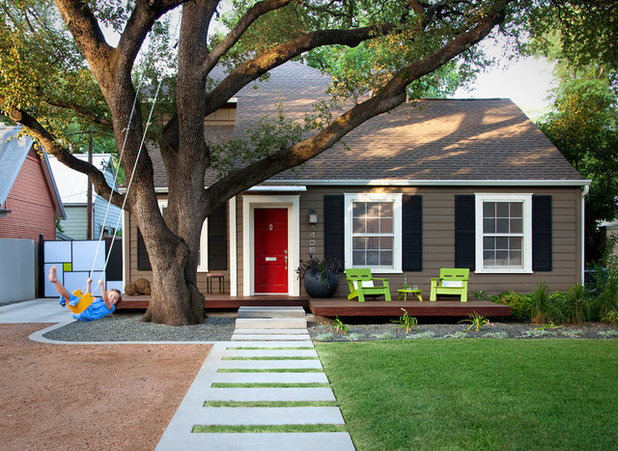
Long the most popular pathway material—safe, easy to maintain. But not boring. Can be tinted at installation or stained later. Poured or cut into unexpected configurations, like this example with turf inserts providing interest and rhythm. For safety, inserts should be low or out of traffic flow.
 The Cultural Landscape Foundation
Stone brings formal, informal, or contemporary feel depending on installation, shape, color, texture. Different stones combine for textural interest. Generally more expensive but works in most applications as a natural material connecting meaningfully with land.
 Miriam's River House Designs, LLC
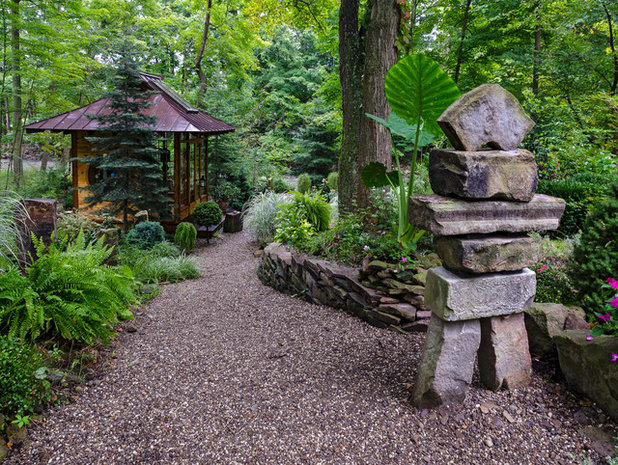
Opinions vary on gravel functionality—I love it. Not for every situation (steep slopes, wheelchair access needed), but it's from the earth, adding natural feel. It crunches underfoot, adding another garden experience layer.
 Calgary Landscaping Service
Traditional across the U.S. and Europe. Doesn't naturally connect with land but grounds a brick home into the landscape. Dry-laid in sand, mortared, or veneered over existing paving. Properly installed, long-lasting.
 Grounded
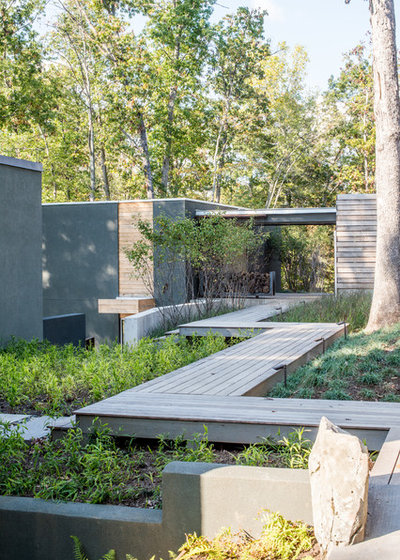
Lumber (dense like ipe or pressure-treated) suits boardwalks avoiding soil contact. Generally sealed, stained, or painted—latter two offer color design choices. The path itself can suggest and manipulate garden mood.
 Jay Sifford Garden Design
Few things are as peaceful as walking a mulched path through woodland. Inexpensive, easily sourced/installed, available in types/hues. Contained within timber/metal edging or spread freely for suggested paths without rigid formality. Finer mulch needs more frequent replenishing than larger grades.
 Classic Nursery & Landscape Co. / Alan Burke, asla
Few consider turf a path material, but it's probably the most environmentally friendly use. Here, turf separates planting beds, blends with planting scheme, adds useful texture.
 Rebecca Smith Garden Design
Impromptu paths mown through fields conjure childhood exploration and delight.
 Luciole Design Inc.
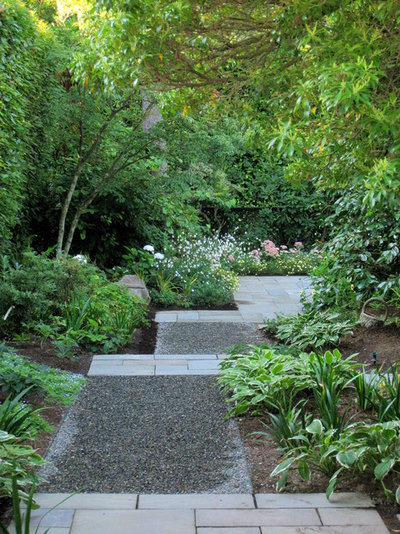
For added interest or architectural connection, combine materials successfully by remembering the four juxtaposition attributes: size, shape, color, texture. If none match, space looks confusing and disjointed. Match one or two, vary the others.
In the example shown: gray flagstone's texture and color relate to concrete step; gravel's color relates to stained boardwalk section; flagstone's texture relates to gravel; stained boardwalk's shape and texture relate to deck. Result: homogeneous, not disjointed, full of interest.
Garden Lighting Design: Maximize Beauty After Sunset
Potager Garden Design: Create a Beautiful, Productive Kitchen Garden
Designing a Child-Friendly Garden: Safe, Fun, and Adaptable
How to Design a Garden: 8 Steps from Dream to Planting Plan
Design a Lush Shade Garden: Plants, Color & Tranquil Spaces
Punctuate Your Garden: Designing Landscape as Narrative
Create a Landscape That Squares Up: Geometry in Garden Design
Garden Design Software Reviews: Best Programs for Homeowners and Professionals
Color in the Perennial Garden: Design with Feeling
Design a Stunning Flower Garden: Styles, Shapes & Plant Combos
Designing Gardens with Plant Height: Scale and Layering Techniques
How to Spread Stormwater Across Your Landscape for Natural Filtration
Designing a Stunning Garden on a Sloped Lot: Expert Strategies
Copyright © www.100flowers.win Botanic Garden All Rights Reserved