


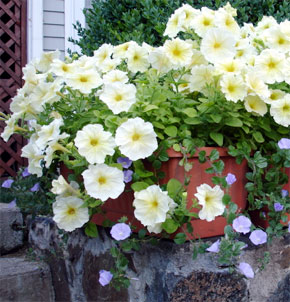
Customer photo by John R. of Salem, Mass.: "I put two windowboxes together to form a right angle in front of my boxwood bushes. I started all of the Limoncello petunias from seed using the Gardener's Supply APS seedstarter kit."
Until a few years ago, annual choices were limited to geraniums, impatiens, marigolds, red salvia. Today, greenhouses offer eye-catching arrays. Whether planting windowboxes, lining sidewalks, or spicing up perennial gardens, here's how to maximize what's available.
Strictly speaking, an annual completes its cycle (seed to flower to seed) in one growing season. Annuals pack a lot of living into a short time.
Beyond this, many plants we treat as annuals are actually tender perennials (impatiens, heliotrope, tuberous begonias) that can't survive frost. Others (pansies, ornamental cabbage) are cold-hardy and withstand freezing.
Annuals offer incredible diversity and versatility for exciting color, form, texture combinations all season. Colors range from bright midsummer zinnias and Mexican sunflowers to subtle pastels of stock or lavatera.
Select annuals for characteristics beyond flower color: tall, medium, short, climbing; sun or shade preference; special virtues like fragrance (stock, mignonette, nicotiana) or attractive foliage (caladium, coleus, dusty miller).
Tender perennials won't survive winter in your climate. Many gardeners enjoy them for one season. Others move plants inside: as houseplants, taking cuttings, or storing roots/bulbs for replanting.
Examples: tender flowering sages (Salvia coccinea, S. patens, S. splendens), verbenas, hyssop (Agastache). Geraniums and scented geraniums (Pelargonium) can be grown outdoors summer, brought indoors fall: to bloom in pots, store in darkness, or use as cuttings. Petunias, coleus, sweet alyssum (Lobularia maritima) can be overwintered in pots.
With a sunspace or greenhouse getting winter sun and staying above freezing, try "annuals" that are perennial shrubs/trees in native habitats. Fuchsias grow rapidly, reach 18 inches to 12+ feet, produce pendulous blossoms in red, purple, white nearly all winter. Brugmansia (angel's-trumpet) grows to 15 feet in greenhouse—fragrant, beautiful, but extremely poisonous if small children present.
Flowering plants from tender bulbs (dahlias, gladioluses, cannas) are often planted as annuals in cutting gardens. They're tender perennials; most won't survive winter outdoors in North America. Easy to dig up bulbs and store indoors for replanting.
Seeing annuals at nurseries, you might wonder who starts from seed. Economic advantage: $2 seed packet grows four flats of alyssum—~$70 savings over nursery plants.
Equally compelling: even best garden centers don't carry full selection of worthy annuals. Most sell popular bedding plants; hard to find old-fashioned annuals like love-lies-bleeding (Amaranthus caudatus), four o'clocks (Mirabilis jalapa), lavatera (Lavatera trimestris).
Partly economics (supply/demand), partly plant nature. Garden centers like selling six-packs already blooming for instant gratification. But many fine annuals won't bloom in six-packs: too tall, dislike transplanting, or won't flower until in ground for weeks. To experiment with the full palette, you'll want to grow some from seed.
Many annuals direct-sow easily. Others best started indoors under lights late winter/early spring. Consult seed catalogs, packets, or From Seed to Bloom by Eileen Powell. Generally, plant seeds at depth 2-3x their diameter.
Some annuals self-sow readily under right conditions, producing new plants next year. Common self-sowers: ageratum, petunia, foxglove, annual larkspur, forget-me-not, calendula, wild/striped mallow (Malva sylvestris).
Hardy annuals: Direct-sow early spring as soil can be worked. For earlier start, sow indoors 8-10 weeks before last frost, transplant ~month later after hardening off. Some can be fall direct-seeded for earlier bloom—plant deeper, mulch after ground freezes. Examples: bachelor's-buttons, calendula, spider flower (Cleome hasslerana), pinks (Dianthus), larkspur, linaria, Shirley poppies (Papaver rhoeas), nigella, scabiosa, snapdragons, lavatera, annual baby's-breath (Gypsophila elegans), heliotrope, stocks, sweet peas.
Half-hardy annuals: Direct-sow after hard frost (below 25°F) passes. Indoors: 6-8 weeks before last frost, harden off before transplanting. Once hardened, withstand light frost. Examples: statice, nicotiana, painted-tongue (Salpiglossis sinuata), China aster (Callistephus chinensis), salvias, chrysanthemums.
Tender annuals: Direct-sow only after all frost danger passes. Indoors: 4-6 weeks before last frost. Examples: marigolds, morning glories, zinnias, sunflowers, tithonia (Mexican sunflower), cosmos, amaranth, ageratum, celosia, gomphrena (globe amaranth).
Late summer/early fall ideal for cuttings from geraniums, coleus, impatiens—pot for winter bloom indoors or hold for next spring.
Soil preparation and planting: Annuals prefer well-drained soil pH 6.3-6.7. Dig in peat moss/compost for organic matter and quick root spread. Set out at recommended spacing. If potbound, gently break apart root mass before planting. Fertilize at planting with organic/slow-release fertilizer.
Pay attention to hardiness (hardy, half-hardy, tender) for transplant timing. Some nurseries label hardiness; when in doubt, plant after all frost danger. Also crucial: sun vs. partial shade preference.
If holding plants in flats >couple days, water and keep in partly shady protected spot (porch, under tree). Not in garage with cars/gas machines—ethylene gas causes flower damage and leaf drop. Transplant ASAP after bringing home.
Care of annuals: Most bloom all season until cold/frost. For continuous bloom and good looks, simple maintenance needed.
Deadheading is most important: pinch off fading flowers. Annuals live to flower, set seed, die. Deadheading keeps them flowering; stopping lets them put energy into seeds. Quick, easy, ensures season-long bloom.
If fertilized at planting with granular organic slow-release, no need to fertilize again. Overfertilizing causes lush foliage at flower expense. Exception: container plants need water-soluble fertilizer every couple weeks.
Annuals have shallow roots—need regular water. Avoid overhead watering (stains petunias, promotes botrytis fungus on zinnias, geraniums, marigolds). Use soaker hose, drip irrigation, or water at soil level.

When shopping, think color and form.
Annuals offer maximum flexibility—one season only. Don't like the effect? Try again next year without moving perennials.
Popular as bedding plants: brightly colored combinations in beds accessible from all sides. Solid blocks of single variety/color create formal effects. Neat lawn strips between single-color plantings add formality.
Even more impressive: massed single-color planting divided by a band of complementary color/habit. Example: bluish-purple border lobelia (Lobelia erinus) with white sweet alyssum (Lobularia maritima)—both low, mounding, tender perennials grown as annuals.
Annuals work in less formal designs too, filling important color roles. Insert into open spots between perennials and flowering shrubs. Adding annuals to perennial borders ensures color continuity when perennials aren't blooming. Great for rhythmic color splashes, linking garden parts, carrying color themes all season.
Best for mixed borders: tall species like nicotiana (flowering tobacco), cleome (spider flower), lavatera, Shirley poppies, foxglove, matricaria, Mexican sunflower (Tithonia rotundifolia). For mid/late-season front-of-border color: impatiens, matricaria, Salvia horminium, sweet alyssum.
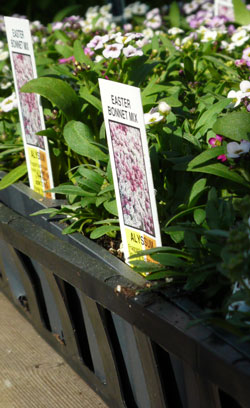
Sweet alyssum is one of the most popular annuals.
With diverse heights, colors, forms, you can plant spectacular annual-only borders. Since most bloom simultaneously over extended season, choose complementary varieties. Create color schemes (pink/blue/white; yellow/blue/orange) or full riot of color.
For designerly effect, include foliage annuals as foils for bright blooms. Silver dusty miller (Senecio cineraria) is classic, but others: cannas (tropical, sometimes bronzed leaves), plectranthus (soft silvery leaves), perilla (Perilla frutescens)—dark purple fringed leaves effective with white/pink-purple flowers.
Climbing annuals suit cottage gardens and containers (window boxes, hanging baskets). Old-fashioned informal quality creates colorful living tapestry on fences, screens, trellises. Morning glories (Ipomoea purpurea, I. tricolor) and relatives moonflower (I. alba), cardinal climber (I. x multifida) are popular—but barely scratch the surface of great climbers.
Annuals are perfect for containers, alone or combined. Be imaginative with containers—don't just stick to terra-cotta. Windowboxes designed for annuals, especially cascading ones. Hanging containers suit trailing varieties like nasturtium 'Empress of India'. See Planting a Winning Container.
Impatiens beautiful in filtered shade containers. Usually round in large containers (half whiskey barrel). For distinction, try old soapstone sink or hypertufa planter. Brown fiber pots widely available, last several seasons, light and movable.
Ensure adequate drainage. If no holes, insert smaller container with holes, or add stone/foam peanut layer.
Container annuals need regular watering/fertilizing all season. Deadhead spent blossoms. Hot dry weather may require watering once/twice daily. Some prefer drier soil: moss rose (Portulaca grandiflora), calliopsis (Coreopsis tinctoria).
Protect tender annuals from early frosts. Warm fall days often follow first frosts—cover plants to prolong season. Once cool weather norms and frost kills plants, remove from pots, clean with soap/water or dilute bleach for next year.
Season end doesn't mean annuals end. Tender perennials in containers can be cut back and brought indoors. Bedding plants (petunias, impatiens, lantana, geraniums) can be potted up for prolonged indoor bloom.
Before bringing indoors, check for insects/disease—treat or discard. Cut back 4-6", place in bright light. Greenhouse/sunspace ideal; sunny west/south windows work. After cutting, give liquid plant food—new leaves/flowers soon.
Watch closely first couple weeks—moving shock makes plants vulnerable. Pamper to ease transition.
Some plants can be dug up fall, pruned hard, stored cool/dark until spring: most tender perennials (brugmansia, datura, geraniums). Water sparingly.
Another strategy: take summer/early fall cuttings, start new plants from old annuals. Works well with coleus, plectranthus, licorice plant (Helichrysum petiolare).
Annual Fuchsia: Care, Varieties, and Growing Tips
How to Grow Cannas: A Complete Guide to Planting and Care
How to Dry Annual Flowers: 5 Methods for Lasting Beauty
How to Grow Gazania Plants: Vibrant, Drought-Tolerant Blooms
How to Grow Lobelia: Cool-Season Color for Borders, Baskets, and Wet Spots
How to Grow Mallow (Lavatera): Hollyhock-Like Blooms for Sun and Containers
How to Grow Stock (Matthiola): Sweet-Spicy Fragrance for Cool-Season Gardens
Copyright © www.100flowers.win Botanic Garden All Rights Reserved