


 Grow penstemon flowers if you like butterflies and hummingbirds in your garden.Commonly known as beardtongues, penstemon plants are very popular for their tube-shaped flowers. There are more than 250 penstemon species, and many of them are native to North America. Others originated from certain parts of Asia. These plants belong to the genus Penstemon in the family Plantaginaceae. Usually, penstemon plants grow as shrubs, and can attain a maximum height range of 10 centimeters to 3 meters.As there are numerous species of penstemons, their features may not be uniform. You may come across several species and cultivars with different-colored blooms and varying features. Some of the popular species are firecracker penstemon (Penstemon eatonii) with red dangling flowers; the low-growing bunchleaf penstemon (Penstemon heterophyllus) with bluish-purple flowers; the tall desert penstemon (Penstemon pseudospectabilis) that produces magenta flowers; etc.The blooming time extends from summer to early fall. This plant produces dense spikes with bell-shaped blooms. Each flower has two lips - the upper one with two lobes, and the lower one with three lobes. This feature may not be prominent in all species. While some species have lance-shaped leaves, slightly broader leaves are seen in others. The common foliage color is green, but there are some species having purple-red leaves too.
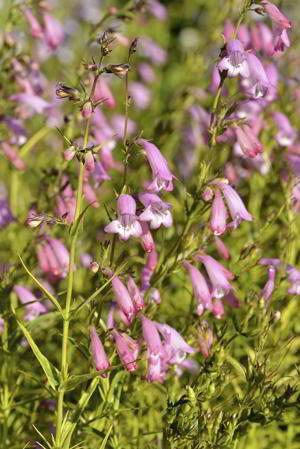 The common name 'beardtongue' is derived from its hairy staminodes (sterile stamen),Penstemon barbatus 'Elfin Pink'
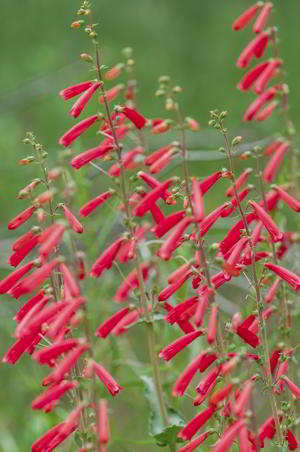 Firecracker penstemon or Penstemon eatonii How to Prune Penstemon PlantsPenstemon plants are perennials that grow well in USDA zones 4 to 9. Most of the species are drought-tolerant, but hybrids may require frequent watering. These plants need well-drained soil and partial to full sun. When it comes to care, pruning is mainly aimed at the growth of new shoots, for extending the flowering season and for protecting them from frost. Pruning is also beneficial for maintaining the shape and appearance of these plants when they get too leggy.Winter PruningIn colder areas, you have to protect the penstemon from frost. In that case, cut back the plant to a few inches, and cover it with a thick layer of mulch. In regions with mild winters, these plants can be cut back by about a third when they are done with flowering. There must be enough foliage to protect these plants from winter.Spring PruningPruning during this season is meant for boosting the growth of new shoots. You can remove the old stems when the plants develop new shoots during spring. Such pruning enables the plants to direct their energy towards growing healthy shoots and blooms. Before pruning, check whether the new shoots develop from the base of the plant or from old stems. If they are emerging from the base of the plant, you can remove the old stems by cutting them to ground level. If such growths are emerging from the existing stems, the latter have to be cut above the shoots. If there are no new growths, you can cut back the plant just above the lowest set of healthy leaves.DeadheadingRemoval of spent flower spikes may prove beneficial in two ways. It encourages the plant to grow new shoots and another round of blooms, rather than spending energy in forming seeds. It prevents seed formation and growth of unwanted penstemons in other locations. While removing the flower spikes, make sure that you cut them just below the first set of healthy leaves located below the blooms. You can also leave a few flower stalks on the plant itself, if you want seeds.
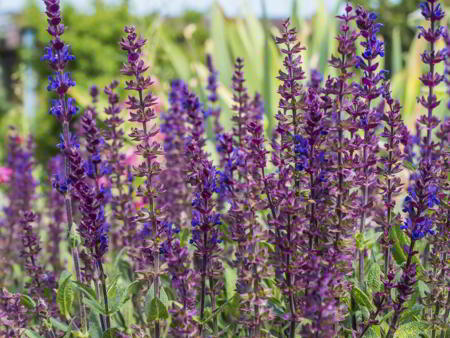 Deadheading triggers production of new bloomsIn short, you can prune penstemons if you want an extended flowering season or to grow healthy plants. Even diseased and damaged stems have to be removed at times. Sometimes, these plants may get leggy, and pruning helps in maintaining their health as well as their appearance.Penstemon PropagationPenstemon plants can be propagated using their seeds or stem cuttings. Root division is another method of propagation. You can start the seeds outdoors after the last frost when the soil gets warm. These seeds can also be started indoors before the last frost. All you need to do is to place them on a well-draining potting mix or soil, cover them lightly, and spray some water.
Copyright © www.100flowers.win Botanic Garden All Rights Reserved