


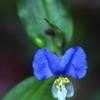
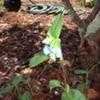
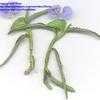
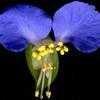
Asiatic dayflower (Commelina communis) is an annual herb native to East Asia, now naturalized across much of North America. Its striking, true-blue flowers—rare in the plant world—last only a single day, but are produced continuously from summer to frost. Despite its beauty, it is considered an invasive weed in many regions.
Prostrate to ascending stems 30–90 cm long, rooting at nodes. Leaves are lanceolate, 3–10 cm long, sheathing the stem. Flowers have two large, vivid blue petals and one small, inconspicuous white petal, 1–1.5 cm wide. They open in the morning and wither by afternoon. Fruit is a two-valved capsule with 2–5 seeds.
| Family: | Commelinaceae (ko-mel-ih-NAY-see-ee) |
| Genus: | Commelina (kom-uh-LIN-uh) |
| Species: | communis (KOM-yoo-nis) |
Thrives in moist, disturbed soils: gardens, fields, roadsides, stream banks. Spreads by seed and vegetatively via rooting nodes. Seeds remain viable in soil for years. Listed as invasive in several U.S. states; outcompetes native vegetation in wetlands and floodplains.
Hand-pull before seed set; remove all rooting nodes. Mulch heavily to suppress germination. Pre-emergent herbicides in spring. No biological controls established. Do not cultivate or share this plant.
The genus name honors Dutch botanists Jan and Caspar Commelin. The two blue petals represent the two brothers; the tiny white petal, their less-famous sibling. Young shoots are edible (cooked) in some Asian cuisines.
Hosta 'Blue Shadows' – Deep Blue Foliage for Serene Garden Spaces
Hosta 'Blue Mammoth' – Colossal Blue Foliage for Grand Gardens
Hosta 'Blue Splendor' – Refined Blue Elegance for Shaded Borders
Buckshaw Blue Hosta: A Blue-Leaved Cultivar from 1986
Blue Arrow Hosta: A Narrow Blue Cultivar from 1982
Hosta 'Blue Moon': Classic Blue-Green Hosta with Rounded Leaves
Hosta 'Yankee Blue': Intense Blue-Green Hosta with a Patriotic Name
Hosta 'Wheaton Blue': Classic Blue-Green Hosta with Heavy Substance
Hosta 'Hadspen Blue': Classic Intense Blue Hosta from England
Hosta 'True Blue': Dependable Blue-Green Hosta with a Honest Name
Copyright © www.100flowers.win Botanic Garden All Rights Reserved