


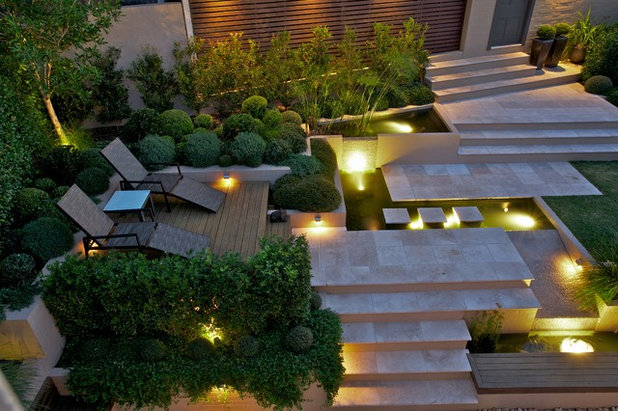
An untouched, steep Northridge (Sydney) site with an unusable sloping lawn and carport view became a multi-level oasis. Landscape designer Ken Pattinson of Art in Green integrated tumbled travertine patios, water features, and soft greenery across a 7-foot grade change on 1,650 square feet.
Several travertine patios connect via elegant stone stairs. Curry leaf (Murraya koenigii, zones 10–12) and lilly pilly (Syzygium spp.) hedges disguise dramatic level shifts, making the garden feel approachable. The carport wall, clad in wood, gains warmth and anonymity.
Brushed chrome fixtures beckon visitors up stairs, across stepping stones, and over wooden decks. Water feature lighting highlights adjacent surfaces and plant forms. The main vertical spill spans three patios, linking them: water pumps from the lower level to the top, cascades down, with a one-way valve preventing backflow. A rainwater tank off the garage roof maintains consistent levels.
Bottom-level plantings include imperial bromeliad (Vriesea imperialis, zones 10–11), sweet flag (Acorus spp.), and spiny-head mat-rush (Lomandra longifolia 'Tanika', zones 8–11). Tiny Trev lilly pilly lines the water; papyrus (Cyperus papyrus, zones 9–10) adds height.
Nick Kennedy designed the hardscaping—same travertine on stair treads, water feature coping, and stepping stones. Turpentine (durable Australian hardwood) serves decks, lounge chairs, and carport wall. Japanese boxwood, bay tree, hawthorn, coastal rosemary, and wild thyme are pruned into consistent ball shapes. Repeated materials—turpentine, travertine, cohesive plants—unify the multi-level design.


Using Pasta Water in the Garden: Safe if Unsalted
Solving Waterlogged Garden Soil with Raised Beds and Drainage
Milky White Water in New Pond: Causes and Cures
Dog-Safe Water Plants for Natural Pond Filtration
Winterizing a Kansas Water Garden: Pump, Depth, Feeding
Clearing Dirty Water in a New 300-Gallon Plastic Pond
Best Aquatic Plants for Water Gardens: Marginals, Lilies, and Edge Plantings
Garden Stream Design: Naturalistic Water Features That Flow Through Your Landscape
Fine Gardening as Art: Creating Your Living Masterpiece
Water Garden Supplies: Natural Solutions for Healthy Ponds
Water Gardening: Design, Build, and Enjoy a Backyard Pond
Water Garden Decking: Design, Construction, and Finishing Touches
Four Great Garden Plans: Entry, Water, Herb, and Wildlife Gardens
Create an Edible Water Garden: Grow Delicious Aquatic Plants
Copyright © www.100flowers.win Botanic Garden All Rights Reserved