


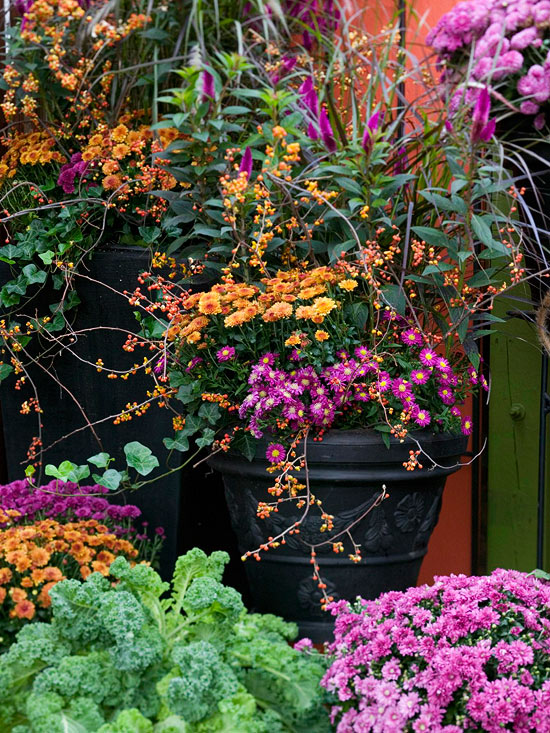
When fall arrives, it's hard not to regret the passing of summer blooms: pompon dahlias, Shasta daisies, African daisies, zinnias, asters, coreopsis, calendulas. But the fall garden offers all these flower shapes from just one plant: the chrysanthemum. Hundreds of hardy cultivars provide an array of colors and bloom shapes, making mums the divas of autumn. Blooms last weeks, not days, and sheer flower count per plant proves this flower loves to show off. Add the mum's impressionistic abilities to its longevity, and you have a plant that pulls its weight.
If you live in a mild winter climate, try these cold-season flowering plants.
Because of their tight, mounded habit and stunning bloom cover, garden mums are perfect for mass plantings. For maximum effect from afar, stick to one or two colors. Or arrange a gradual transition of related colors. Look at your yard to see what complements existing landscape.
If you decorate with pumpkins and gourds, choose orange, bronze, yellow, creamy white mums. With evergreen backdrops, try bright pinks, lavenders, pure whites, or reds. Bold colors excite even drab fall landscapes.
Learn more about chrysanthemums.
Garden mums make great container plants. Pop into a clay pot, line up in a window box, or center a mixed container with trailing foliage. Landscape plants provide backdrops: ornamental grasses, neon purple beautyberry berries (Callicarpa), smoke tree (Cotinus), variegated sedum, dwarf Fothergilla gardenii, or conifers.
Choose cultivars by bloom time. Coordinate bloom time with fall length in your location. Most withstand light frost, but right cultivars provide longest pleasure.
Mums aren't as expensive as many perennials, so plant as annuals without worry. Impulse buyers will see colorful pots and not resist. Fall planting lessens winter survival since roots don't establish. For something permanent, plant in spring with proper care (mulching, pinching) to encourage compact growth and more blooms. This improves overwintering and reblooming next year. Some produce spring blooms before pinching for fall.
Florist (cutting) mums and hardy (garden) mums come from the same golden-yellow daisylike mum from China. Today's hybrids result from endless crosses between Chinese and Japanese species. Different types perform for two distinct purposes.
Florist mums are large-flowered with many bloom forms (quilled, pompon, spider). Grown in greenhouses as indoor plants, they produce few underground stolons needed for cold survival. Planted outside, they're short-term bedding plants removed when blooms fade. A potted florist mum may grow summer but won't survive winter. Garden mums produce underground stolons and survive cold better. Most are perennials in Zones 5-9, tougher than florist types. Some cultivars less hardy, killed by early spring frost.
Whether you want a quick color splash or a border fixture, mums are the pick for fabulous fall.
Location. At least 6 hours sun daily. Less sun = tall, leggy, fewer/smaller flowers.
Soil preparation. Well-drained soil. Amend heavy clay. If soggy after rain, use raised beds with friable soil. If soil too dense, add compost to 8-12 inches depth. Mums' roots are shallow; plant 1 inch deeper than nursery pot, careful with roots.
Trim previous year's stems as new spring growth shows.
Watering. Water newly planted thoroughly, never let wilt. Established: ~1 inch per week. When bottom leaves limp or brown, water more. Avoid soaking foliage (encourages disease).
Fertilizer. Spring plants: 5-10-10 once/twice monthly until cool weather. Don't fertilize fall annuals. Overwintering plants: high-phosphorus fertilizer to stimulate roots.
Overwintering. After first hard frost, mulch up to 4 inches with straw or shredded hardwood. Fill around entire plant, between branches. Pinch dead blooms, leave branches intact. Better survival if you wait to prune old stems until spring. As weather warms, pull mulch to allow new shoots.
Dividing. Perennial mums need division every couple years. Spring after last hard frost and new growth shows. Dig up in one piece, separate outer pieces from center with clean sharp spade/knife. Replant outer portions in rejuvenated bed; discard original center.
Pests. Aphids, leafhoppers, spider mites may appear but unlikely to harm.
Key to full, rounded domes is pinching for more branching and compactness. Don't hold back—few minutes rewards thick, solid plant.
Fall-purchased large plants already pinched, ready for planting. Young spring plants need pinching for maximum bloom and shape.
Start pinching at good flush of buds. Pinch half the tender new growth at top of shoot; choose some stems with buds, some without. Repeat every 3-5 inches of growth (every 2-4 weeks) until July 4. Stopping then ensures good bud formation and fall blooms.
Recently introduced cultivars at local nurseries:
'Blizzard' Extra-late, largest (2½-inch) whitest daisy garden mum. Ball-shaped, bright white blooms over extra-dark green foliage.
'Bold Felicia' Early blooms: neon-hot pink daisy with bright yellow center.
'Carrie' Hard-to-find two-tone decorative: dark red-bronze center, golden-yellow outer petals. Extra-late, no discoloration of aging petals.
'Melissa' Extra-late, blooms through late October. Bred for excellent form, color, retention, habit. Bright lavender-rose combines with 'Erica', 'Ingrid', 'Taffy'.
'Vicki' Bright "wow": decorative blooms rich orange with darker orange center. Awesome color, full spreading habit.
'Zesty Jean' Unusual pastel peach-coral. Early decorative, more fully petaled, retains color longer.

Mums come in an array of bloom forms. Most common:
Decorative—long, tightly overlapping petals, incurve (curve up/in) or reflex (curve out/down).

Pompon—small, globe-shape, petal-packed.

Single or Daisy—one row of long petals around flat center disk.
Anemone—one or more rows of single flat petals topped with raised center of tiny disk florets (usually darker).
Semidouble—two or three rows of long petals around center disk.
Single Quilled—single daisy type with tubular petals. Different from full quill (almost always florist mums).
Indoor Herb Gardening: Recreate Outdoor Conditions for Year-Round Harvests
Perennial Care Guide: Keep Your Flowers Returning Year After Year
Bird-Proofing Your Garden: Professional Strategies That Work
How to Choose the Right Garden Storage Shed
Three Essential Fall Garden Tasks for a Better Spring
Gardening Basics: No Green Thumb Required—Just Water, Sun & Soil
Growing Tulips in Your Garden: A Spring‑Time Delight
Vegetable Gardening from Seed to Harvest: A Complete Guide
Complete Guide to Growing Healthy, Beautiful Garden Roses
Complete Perennial Care Guide: Planting, Dividing, Watering & More
The Ultimate Garden Planning Guide: Dreams, Designs, and Practical Steps
October Garden Checklist: Regional Tasks from Soil Prep to Leaf Mulching
After-Summer Care for a Fabulous Fall Garden: Assessment, Planning & Prep
Copyright © www.100flowers.win Botanic Garden All Rights Reserved