


Some gardens tell stories; some are deeply personal extensions of their creators; others work in concert with nature where the human hand steps back. Rarely do all three converge. MapleWalk, in suburban Charlotte, North Carolina, by Lib Jones and Tom Nunnenkamp, achieves this — unspoiled woodland beauty, an outstanding tree and shrub collection, and gentle whimsy.
I visited on a crisp fall day. Low autumn sun backlit Japanese maples mystically. Tom and Lib shared their story — romance, land love, passion for creating beauty — as interesting as the garden itself.

Tom and Lib bought in 1990, shopping for garden potential first; house second. Typical Southern gardeners initially — azaleas, boxwood outdoors, African violets indoors. Today, MapleWalk retains Southern charm with camellias, azaleas, and crape myrtles, but is so much more.

The garden spans 2.25 acres, previously three parcels. The second parcel required years of patience before the owner sold. The third contained a home purchased for Lib's late father; now rented with garden access for Tom and Lib. The second parcel was smothered in wisteria and poison ivy — meticulously removed over weekends, revealing construction rubble. They removed 100+ trees, raised the canopy for light, brought in 40+ tons of boulders, discovered a 28-foot grade change. Then they planted.

They received a Japanese maple (Acer palmatum dissectum 'Red Dragon', zones 5–8) as a wedding gift. Here the magic begins. A storm-felled limb broke the tree in half; Tom saw a pruning opportunity. Lib calls him "The Happy Pruner." Tom prioritizes form over color. MapleWalk hosts 92 Japanese maple cultivars, 50+ conifers, 27 dogwood types, 9 redbud varieties.

The hosta path near the entrance overlooks the ravine — a celebration of woodland canopy and understory layers.

A small figure clings to a branch-handrail — testament to MapleWalk's subtle whimsy.
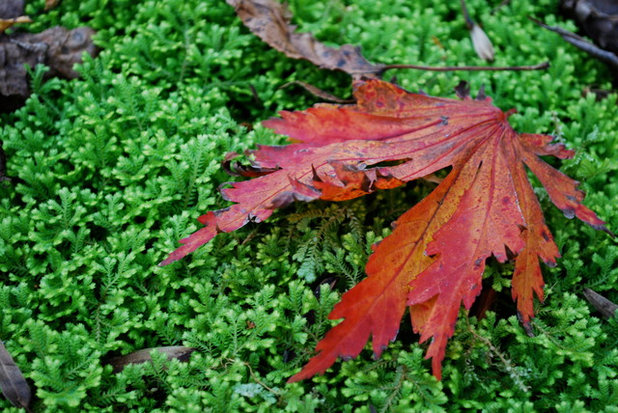
True beauty lies in serendipitous details: club moss (Selaginella kraussiana, zones 6–10) and full-moon maple (Acer japonicum aconitifolium 'Dancing Peacock', zones 5–8) compose autumn's fleeting beauty.

Brightly colored pottery shines: a pot holds weeping 'Ryusen' maple, backdrop for another.

Clear autumn sky foils a big-leaf magnolia (Magnolia macrophylla, zones 5–8) with leaves over 30 inches long.

Unique false larch (Pseudolarix amabilis, zones 4–8) — a deciduous conifer with spectacular fall color and texture, foliage like holiday fireworks.

Lib anticipates her 'Welch's Pink' beautyberry (Callicarpa americana 'Welch's Pink', zones 6–8) — a rare pink-fruited cultivar worth the wait.

Camellias anchor Southern gardens. Tom experiments training certain cultivars as ground cover — fall-blooming Camellia sasanqua 'Chansonette' (zones 7–10) grows laterally; new growth pinned to ground until maturity, a unique use for this Southern favorite.

No Southern garden is complete without crape myrtle (Lagerstroemia spp., zones 6–10). This specimen seemed to harness and glow with afternoon light.

Tom and Lib feel privileged to call MapleWalk home, actively planning a foundation to oversee its future — a tranquil respite from modern frantic pace.
A Pergola Story: From Garden Structure to Songbird Sanctuary
DIY Garden Hedging: Essential Tools, Techniques, and the "Less Is More" Rule
Identifying Common Garden Pests: From Aphids to Weevils and How to Spot Them
Common Garden Plant Pests and How to Identify Them
Garden Fence Posts: Metal, Wood, Fiberglass, or Vinyl?
Landscaping with Roses: Groundcovers, Hedges, and Bed Design
Designing a Productive Vegetable Garden: Sun, Support & Succession
Finding a Reliable Garden Nursery in Southam
Cedar Garden Sheds: The Eco-Friendly, Low-Maintenance Storage Solution
Vertical Gardens: Transforming Walls into Living Art
Reasons to Love Your Pop-Up Greenhouse
Creative Terra Cotta Pot Projects: Garden Crafts for Every Style
Copyright © www.100flowers.win Botanic Garden All Rights Reserved