


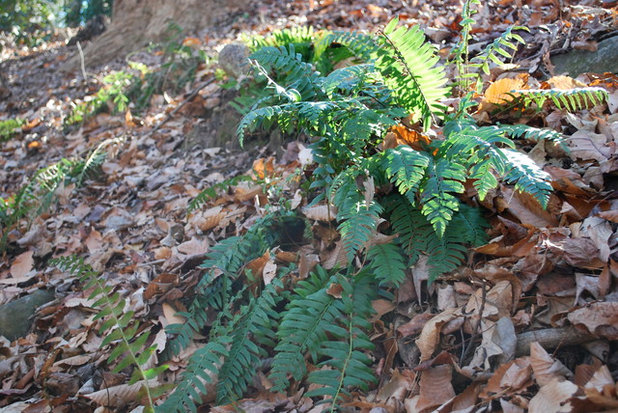
The woodland forest in winter is a study in death and decay, its floor strewn with ocher and brown leaves that crunch underfoot. Along the path, Christmas fern (Polystichum acrostichoides) breaks through, offering a respite and glimmer of spring's rebirth—nature's holiday gift.

Botanical name: Polystichum acrostichoides
Common name: Christmas fern
Origin: Eastern U.S. and Canada
Hardiness: Hardy to -40°F (USDA zones 3–8; find your zone)
Light requirement: Partial to full shade
Water requirement: Consistently moist soil best for optimal growth, though in nature it often grows in dry soil on hillsides.
Mature size: Up to 2 feet tall, spread up to 3 feet

Benefits and tolerances: Resists deer, rabbits, insects, disease; one of the more drought-resistant ferns but grows well in wet soil; well-behaved.
Seasonal interest: Evergreen; fronds deepen in color as season progresses.
When to plant: Spring or fall preferable.

This evergreen native begins growth in early to mid-spring, sending up fuzzy, tightly curled silver fronds that unfurl to light green. Coloration deepens to a very glossy dark green. It never goes dormant, but fronds may lie flat in cold, snowy weather. These can be removed in mid-spring once new upright growth matures.
Christmas fern grows in a cascading vase shape with glossy, leathery, lance-shaped fronds, frequently found on slopes near creeks.

Since it naturally grows near rocky outcroppings on forest floors, it's an appropriate companion for boulders in woodland or Asian-style gardens. Its upright habit pulls the eye upward, contrasting with rounded boulders and lower spreading plants.
Visual impact greatly increases when planted en masse—consider groupings of 10 or more. Its unique texture also creates a "living tapestry" when woven with similar-height plants of different shapes, textures, and colors, adding interest to the predominantly green woodland floor.

Best in moisture-retentive soil; established plants are somewhat drought-tolerant. If planting in drier areas, water regularly several times a week until established. Greatly benefit from mushroom compost or composted cow manure in the planting hole. In consistently wet soil, raise rhizome slightly above soil level and plant at an angle to reduce crown rot risk.
Well-behaved, spreading slowly; rhizomes can be divided in early spring if desired.
More:
Ferns: A Shade Gardener's Best Friend
Browse more Houzz guides to gardening
Cinnamon Fern: A Unique Native Fern with Dramatic Fertile Fronds
Sweet Fern (Comptonia peregrina): A Fragrant Native for Tough, Cool-Climate Sites
Alaska Cedar: A Living Sculpture for Year-Round Garden Structure
Lady Fern (Athyrium filix-femina): Elegant, Well-Behaved Shade Garden Classic
Ostrich Fern (Matteuccia struthiopteris): A Graceful Giant for Shade Gardens
Great Design Plant: 'Charity' Oregon Grape — Winter's Golden Star
Great Design Plant: Roger's California Grape for Spectacular Fall Color
Mr. Bowling Ball Arborvitae: The Perfect Low-Maintenance Conifer
Bird's Nest Spruce (Picea abies 'Nidiformis'): A Winter Garden Workhorse
Winterberry (Ilex verticillata): Deciduous Holly for Frosty Gardens
Japanese Holly Fern (Cyrtomium falcatum 'Rochfordianum'): Evergreen Elegance for Woodland Gardens
Eastern Bluestar: A Perennial Star for Fall Gold and Spring Blooms
Great Design Plant: Autumn Snakeroot — The 'Little Black Dress' of Perennials
Copyright © www.100flowers.win Botanic Garden All Rights Reserved